.jpg "Autocracy 2025: Is there an end in sight to the third wave of de-democratisation?")
Autocracy 2025: Is there an end in sight to the third wave of de-democratisation?
The global regression of democracy, which has been ongoing for roughly a quarter of a century, continued in 2025 to affect virtually all regions, much as in previous years. Forty-four countries exhibited signs of autocratisation, while only 18 showed movement in the opposite direction. At the same time, the number of episodes of democratic decline decreased somewhat compared with the 2015–2020 period, allowing for cautious hope that the peak of the third wave of de-democratisation has already passed.
Nevertheless, in 2025 the number of countries classified as 'closed autocracies' continued to grow, while the number of 'liberal democracies' declined. The year’s most consequential development was the unprecedented regression of democracy in the United States following Donald Trump’s return to the White House.
The main instrument of autocratisation has been the unchecked expansion of executive power against the backdrop of the deepening dysfunction of a Republican Congress that has been ceding authority to the presidential office. At the same time, researchers note that a reversal of autocratisation remains possible as long as the process of degradation has not yet affected the electoral system. Accordingly, attention in 2026 will focus on the US midterm elections and the preparations for them by both sides.
However, a whole ‘constellation’ of elections this year will test the resilience of the new personalist regimes that are undermining the institutional foundations of democracy in countries where it until recently appeared reasonably consolidated. The first such test will be the elections in Hungary, due in ten days.
It is developments in established democracies in 2026 that will serve as the principal indicator of the trajectory of the third wave of de-democratisation and of the prospects for its gradual waning or new resurgence.
The third wave of autocratisation and its dynamics
A decline in democracy worldwide has been observed for the past 20 years, according to the authors of the latest Freedom House annual report on the state of freedom and human rights. Meanwhile, experts from the international V-Dem project argue in their annual review that the retreat of democracy has been ongoing for not just 20, but for at least 25 years, describing it as the third wave of autocratisation.
This concept, formulated by V-Dem’s founder, Professor Staffan I. Lindberg, holds that the three waves of democratisation once identified by Samuel Huntington were each followed by corresponding waves of de-democratisation: from the mid-1920s to the early 1940s, from the early 1960s to the late 1970s, and from the late 1990s to the present. Such reverse waves, however, never entail a return to the original starting point. A degree of global democratic progress can still be observed, although it tends to fall short of the expectations that arise during the upswing of each wave of democratisation.
Three waves of democratisation and autocratisation, 1900–2025, number of countries
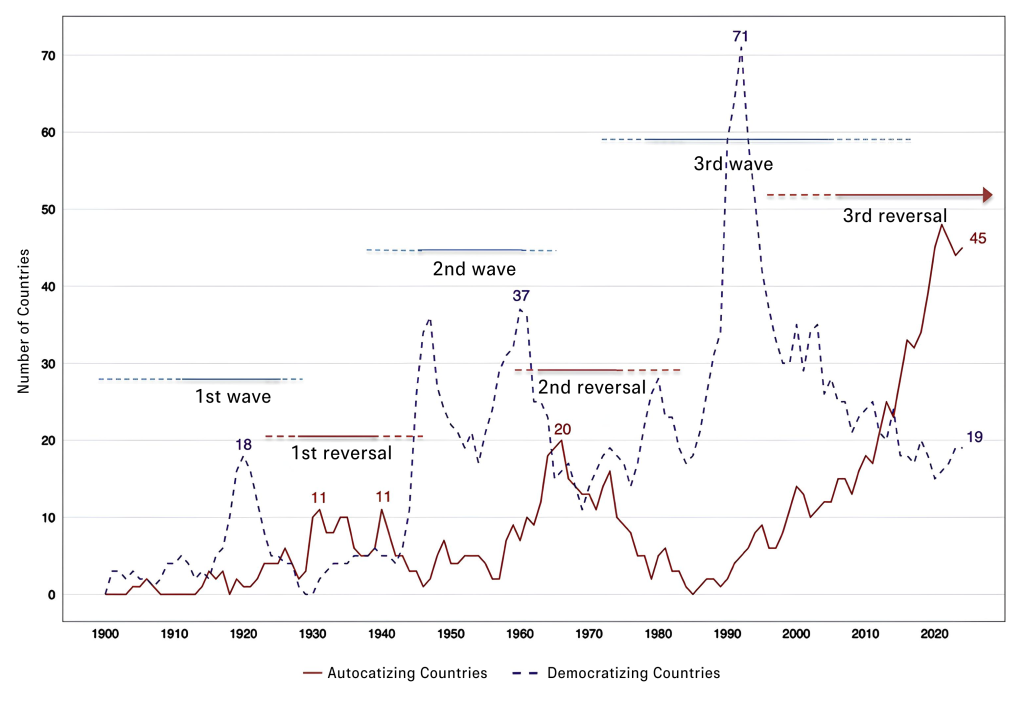
Source: Staffan I. Lindberg. Fifty years of the third wave(s)
During the current, third reverse wave, the process of autocratisation, understood as the deterioration of democratic indicators where democracy exists and the consolidation of autocracy where it does not, is affecting an unprecedented number of countries. This breadth, however, is the mirror image of the preceding and most extensive third wave of democratisation (from the late 1970s to the early 2000s). Between 1970 and 2024 there were 149 episodes of democratisation across 110 countries, while over the same period 105 episodes of autocratisation occurred in 75 countries. As a result, by 2024, 60 of these 110 countries (55%) had become democracies, while 50 did not consolidate as such and reverted to autocratic rule (→ Lindberg: Fifty Years of the Third Wave(s)).
Nevertheless, V-Dem notes that today the crisis of democracy is evident in every region of the world, including Western and Eastern Europe and North America. In 2025, processes of autocratisation were observed in 44 countries, nearly a quarter of all states, whereas only 18 showed signs of democratisation. According to V-Dem’s classification, the world now comprises 92 autocracies and 87 democracies. The number of liberal democracies has steadily declined from a peak of 45 countries in 2009 to 31 in 2025, while the number of closed autocracies has risen from 23 to 35. The situation, however, looks far worse when viewed not in terms of the number of countries, but in terms of population. Only 7% of the world’s population, around 600 million people, live under liberal democracy. A further 1.6 billion reside in electoral democracies (56 countries in 2025). Nearly half of the global population, 3.8 billion people, live in electoral autocracies (57 countries), including Russia, and a further 2.3 billion live in closed autocracies (35 countries).
Lindberg nevertheless observes that, for all its scale, the third wave of autocratisation is unfolding much more slowly than in the twentieth century and typically does not reach the same levels of consolidation and violence seen in that period (→ Lindberg: Fifty Years of the Third Wave(s)). Furthermore, the authors of the V-Dem report note, with considerable caution, that the intensity of de-democratisation peaked in the late 2010s, while in recent years the number of cases of autocratisation per year has declined somewhat, which may indicate that the peak of the reverse wave has already passed.
Analysing trends in political freedom and human rights in 2025 in accordance with its methodology, Freedom House reports that conditions for political rights and civil liberties deteriorated in 54 countries last year, while improvements were recorded in only 35. The pattern was similar in 2024, at 60 versus 34. However, during the period 2015–2020, the average annual number of countries experiencing deterioration stood at 69, whereas over the past five years this figure has fallen to 52, consistent with V-Dem’s observation of a modest easing in the momentum of autocratisation in recent years.
Democracy-2025: coups, continuismo and the ‘decline of America’
Among the various freedoms and democratic institutions, the most significant pressures in 2025 were exerted on media freedom, freedom of expression and legal procedures, affecting both authoritarian and democratic states, according to Freedom House experts. The sharpest declines in freedom were driven by military coups, the suppression of protests and attempts by incumbent leaders to alter constitutional rules to their advantage. In Guinea-Bissau, for example, elections were disrupted by a coup, with armed individuals storming the electoral commission’s office and destroying ballot papers. In Madagascar, the military also overthrew the elected government, bringing the number of African countries that have experienced coups since 2019 to nine.
In Tanzania, the incumbent president Samia Suluhu Hassan was declared the winner of elections marked by the exclusion of opposition candidates, the disappearance of opponents and police violence against protesters that resulted in at least 1000 deaths. In El Salvador, President Nayib Bukele targeted critics of a constitutional reform that removed presidential term limits and opened the way to indefinite re-election. The practice of continuismo, the extension of presidential terms and the removal of term limits, typically signals a shift from semi-authoritarian rule to full autocracy. Among 'partly free' countries, authorities in Georgia and Serbia suppressed peaceful protests.
One of the key consequences of democratic regression in recent decades has been the transition of ‘partly free’ countries into the ‘not free’ category (reflecting Freedom House’s three-tier classification rather than the four regime types used by V-Dem). Over the past two decades, 19 countries have undergone such a transition, according to Freedom House. Among democratic countries, classified as 'free' by Freedom House, the largest declines over the past year were recorded in the United States, Bulgaria and Italy. At the same time, three countries, Bolivia, Fiji and Malawi, improved their status in 2025 from 'partly free' to 'free'. Over the previous 19 years, a further nine countries achieved such an upward transition. In other words, one and a half times as many countries have moved downwards from the intermediate category of 'partly free' as have moved upwards.
However, the most consequential development of 2025 was the regression of democracy in the United States, described in the V-Dem report as unprecedented in American history and addressed across seven of its forty pages. The principal instrument of autocratisation in the US has been executive aggrandisement, that is, the unchecked expansion of executive authority against the backdrop of a deepening dysfunction in Congress. ‘The Republican-controlled Congress seems to have abdicated its constitutional role in favour of the executive branch, ceding significant legislative, fiscal, and oversight powers [to the president] during 2025’, the report’s authors note. The system of checks and balances is also being dismantled within the executive branch itself. This process includes purges of perceived opponents, the removal of oversight by independent agencies and auditors, and the politicisation of the civil service, turning the bureaucracy into a political instrument.
Judicial independence and the principle of equality before the law have been weakened to an unprecedented degree. In addition, the Trump administration has pursued a campaign of pressure against the independent media and freedom of expression. Finally, as noted by Freedom House, the new administration, with the effective acquiescence of the Republican Congress, has systematically ignored conflicts of interest, further eroding anti-corruption safeguards.
The emphasis placed in the V-Dem report on the role of the Republican majority in Congress is significant. According to a growing body of scholarship, the principal mechanism through which personalist regimes dismantle democracy lies not so much in the leaders themselves as in their success in transforming political parties into instruments of personal power (→ Frantz, Kendall-Taylor, Wright: The Origins of Elected Strongmen). However, as the authors of the V-Dem report stress, a reversal of autocratisation remains possible so long as the degradation of democracy has not seriously affected the sphere of electoral procedures. For this reason, 2026, and in particular the forthcoming midterm elections, will be of critical importance for the future of American democracy.
In last year’s review of the current state of democracy and democracy indices, we noted the emergence of a new inflection point in the trajectory of democratic recession (→ Re:Russia: The Crisis Roaming Europe). Whereas earlier analyses tended to link democratic backsliding to the failure of countries that had gained an opportunity during the third wave of democratisation and subsequently reverted to authoritarianism, the erosion of democracy is now increasingly spreading to 'old', established democracies that had previously served as models and contributed to the global appeal of democratic values. The case of the United States under Trump’s renewed presidency represents a particularly stark manifestation of this trend, whose further development risks becoming an additional driver of the third wave of de-democratisation.
A test for strongmen and electoral consensus
In 2026, presidential and parliamentary elections are scheduled to take place in more than 40 countries, including Portugal, Hungary and Sweden in Europe, Japan and Bangladesh in Asia, The Gambia and South Sudan in Africa, as well as Brazil, Peru and the United States. The outcomes will affect roughly one in five people worldwide and shape both the configuration of global alliances and the international agenda. However, in the context of the ongoing democratic recession and the recent successes of right-wing populists (→ Re: Russia: An Ambivalent Supercycle), his year’s elections will above all serve as a test of resilience for conservative charismatic leaders such as Viktor Orbán, Donald Trump and Benjamin Netanyahu, and will indicate the extent to which the political machines of the new personalism, now undermining the institutions of consolidated democracies, retain their momentum.
The immediate and decisive test for these ‘strongmen’ will be the parliamentary elections in Hungary, scheduled for 12 April. Over 15 years in power, Orbán and his party, Fidesz, have consolidated control over judicial and regulatory bodies, promoted an illiberal discourse and altered electoral laws. This time, however, Orbán faces not the traditional systemic liberal opposition but Péter Magyar, a former insider and party functionary who left Fidesz and, in 2024, assumed leadership of the Tisza Party. Magyar presents himself as a liberal conservative, appropriating elements of Orbán’s rhetoric while combining them with a strong anti-corruption agenda directed against Fidesz and a platform centred on the normalisation of relations with the EU.
The Hungarian elections have already acquired global significance. Viktor Orbán is being openly supported in broadly similar terms by both Vladimir Putin and Donald Trump (the latter addressed Hungarian voters directly on 23 March). Hungarian journalists and European intelligence services claim that Moscow has dispatched political consultants to Hungary and is organising aspects of his social media campaign, while Russia’s GRU is alleged to have planned to stage a fake assassination attempt on Orbán on the eve of the vote in order to mobilise his supporters.
Two principal challenges surrounding the forthcoming vote stem from the erosion of electoral procedures during Orbán’s time in office. As a result of gerrymandering carried out by Fidesz in 2024, the translation of votes into parliamentary seats is no longer proportional. According to The Economist’s calculations, the Tisza Party would need to outperform Fidesz by around 6% in the popular vote to secure a parliamentary majority. A second issue is the polarisation of opinion polling. Whilst most surveys indicate a lead for Tisza over Fidesz of 8–13 percentage points, a number of polling agencies aligned with Orbán’s party report, by contrast, a Fidesz advantage of 5–11 percentage points. This divergence points to a high likelihood that the election results will be contested by one side or the other. Moreover, the ‘Sovereignty Protection Act’ adopted at the end of 2023 could hinder international election monitoring and jeopardise the OSCE’s observation mission.
Trust in electoral processes is also a central concern in Israel ahead of the parliamentary elections scheduled for October. According to the JPPI Israeli Society Index, 31% of those surveyed do not believe that the Knesset elections will be fair and free, while 40% are uncertain whether society and political parties will accept the results. Scepticism is higher among citizens of Arab origin (51%) and those on the left of the political spectrum (78%).
Benjamin Netanyahu’s position has been weakened by allegations of breach of trust, bribery and fraud. His efforts to curtail judicial oversight have been widely perceived as an attempt to evade prosecution and, in 2023, triggered the largest protests in Israel’s history. At the same time, deepening political polarisation is eroding trust not only in elections but also in such allegations themselves, which increasingly come to be seen as instruments of political contestation.
According to opinion polls, Netanyahu’s coalition could lose its majority, securing around 52–54 seats in the 120-seat Knesset. Former Israeli Prime Minister Naftali Bennett is positioning himself as a pragmatic and moderate alternative to Netanyahu. Nevertheless, the opposition remains fragmented, and no single party currently has the capacity to form a governing coalition without partners. Bennett will therefore need to articulate a unifying programme for a prospective coalition, a task that is likely to prove difficult. As a result, Netanyahu retains a viable path to remaining in power, though this may require significant concessions and would not guarantee broad public acceptance of the election outcome.
Finally, the mid-term elections in the US on 3 November 2026 will mark the culmination of the confrontation with the new ‘right-wing personalism’ in politics. All 435 seats in the House of Representatives and one third of the Senate will be contested. Historically, in mid-term elections, the incumbent president’s party loses an average of around 25 seats in the lower chamber. Currently, the Republicans hold 218 seats there, and the Democrats 214. Given this distribution, the midterms represent an opportunity for the Democrats to regain control of the House, which could mark a turning point for 'liberal America', which was dealt a blow by Trump’s convincing victory in November 2024.
Data from poll aggregators indicates a 6-point lead for the Democrats (47.6% to 41.6%) in voting intentions for the congressional elections as of late March. At the same stage ahead of both the 2024 elections and the 2022 midterms, the Democratic advantage was smaller. At the same time, the unfavourable course of the US military operation in Iran is currently dealing a further blow to Trump’s popularity. According to aggregated data, the gap between those who disapprove and those who approve of his performance as president has widened from 12.5 percentage points in February to 15.5 at the end of March (56.5% to 41%). Gallup data indicates that the incumbent president’s approval rating has reached its lowest point (36%) since he took office for the second time and is approaching the all-time low (34%), recorded at the end of his first presidential term. When presidential approval falls below 50%, the party controlling the White House loses, on average, up to 37 seats in the House of Representatives, according to Gallup’s calculations.
Trump, of course, still has time to recover at least part of this ground, and his camp is preparing for a sustained fight. Ahead of the mid-term elections, he has attempted to redraw constituency boundaries to his advantage (it is no coincidence that some researchers believe Viktor Orbán’s autocratic practices have, in effect, served as a template for Donald Trump). Democrats are attempting to respond in kind. Success in such efforts could yield between one and five additional seats per redrawn district for either party. However, any such changes will test the electoral consensus, that is, the willingness of both sides to accept the legitimacy of the results. More broadly, potential confrontations over electoral procedures are likely to be among the most acute and consequential issues for the future of democracy in the months ahead.
Republicans are likely to retain their majority in the Senate, although they are expected to lose several seats. If Democrats succeed in regaining control of the House of Representatives, this would result in a divided Congress. Under such a scenario, most major legislative initiatives of the Trump administration would be blocked, while Democrats would be able to initiate investigations into the administration’s actions and strengthen oversight of the budgetary process and appointments.
Thus, developments in established democracies in 2026 will serve as the principal indicator of the trajectory of the third wave of de-democratisation and of the prospects for its gradual waning or new resurgence.