The Shadow of Stalin: Why and How Russia is Memorialising the Tyrant Once Again
In May 2025, a large bas-relief depicting Stalin was unveiled at the Taganskaya metro station in Moscow. In the same month, monuments to Stalin appeared in the Bashkir village of Amirovo and the Vologda settlement of Kaduy. In July, the commander of the Baltic Fleet presented a bust of the 'leader of the peoples' to the Kaliningrad Officers’ House, while a school in the town of Nikolsk, Vologda Region, placed a statue of Stalin at its entrance. The new memorialisation of the 'leader of the peoples' is spreading across Russia. In just the first seven months of 2025, 16 new memorial plaques and busts of the tyrant appeared in Russian towns and villages, and in total, at least 213 new monuments to Stalin were installed in Russia between 1995 and July 2025, according to calculations by Alexandra Arkhipova and Yuri Lapshin.
In their article for Re:Russia, based on a meticulous analysis of the dynamics and geography of Stalin's rememorialisation, they paint an unexpected and complex picture. Rememorialisation is not primarily the result of any deliberate policy. This rememorialisation is not initially the result of any deliberate policy. At its roots lie several grassroots and diverse initiatives, reflecting different aspects of the Stalin myth, including those driven by a protest-inspired demand for 'justice' in its paternalistic sense. These initiatives, however, resonated with two trends in Kremlin ideology of the late 2010s and early 2020s: the myth of 'our shared great past', untainted by internal divisions and finding its continuation in the present, and the tendency to suppress the memory of Stalinist repressions. As a result, a multi-layered 'normalisation' of Stalin is taking place, along with the normalisation of repressions as an integral part of the great past and present.
Stalin's memorial renaissance, 1995–2025
If you google how many monuments to Stalin exist in Russia, you will most likely see the number 110. This figure is inaccurate and outdated. In reality, the number of memorial objects associated with Stalin is almost twice as high.
To understand how the phenomenon of the new memorialisation of the 'leader of the peoples' is structured, we collected and cross-checked data from scratch using open sources, relying on archives of Russian media from the past 30 years aggregated in the Integrum World Wide database (which contains almost all Russian online and print publications). Readers of the Telegram channel ‘(Un)entertaining Anthropology’ actively assisted us in compiling this database, for which we are very grateful. In our calculations, we included only new (no earlier than 1996) and reconstructed memorial signs and objects with confirmed installation (a press article with a photograph). If a monument was later dismantled, we still counted it in the database, as the act of installing the memorial in public space is what matters for our purposes. Monuments that have remained unchanged since the 1970s–1980s (when the first revival of Stalin memorialisation began) were not included in our calculations.
The collected data allow us to state that between 1996 and 2025, 13 private museums dedicated to Stalin’s life opened in Russia, and 177 memorial plaques, busts or full-length statues of the 'leader of the peoples' were installed or reconstructed. To this we must add 14 bas-reliefs, pylons and mosaics (including an inscription on a mountainside in the Irkutsk region and the reconstruction of Stalin’s portrait in the Tseysk Gorge in North Ossetia). Finally, we encountered several cases where a sculpture of Stalin or his name was used as advertising for commercial enterprises (six instances). We also counted the renaming of streets and squares (as well as the Volgograd airport) in honour of the 'leader of the peoples'. We refer to all these practices as 'immovable' memorialisation (a total of 213 memorial objects).
But this is not where the ways of commemorating Stalin in urban space end. In the mid-2000s, 'movable' memorialisation of Stalin emerged. At least three times a year – on 9 May, 21 December (Stalin’s birthday), and 5 March (the day of his death) – in some Russian cities, thanks to the efforts of Communist Party (KPRF) activists or private enthusiasts, several streets are decorated with banners depicting the generalissimo and his statements (sometimes fabricated). On these days, one can see a retro train with Stalin’s portrait (as in Yekaterinburg) and ‘Stalin buses’ – public transport vehicles (in St Petersburg, Penza, Perm, etc.). KPRF activists organise motorcades, ski marathons, and extreme races. Unlike monuments, memorial performances exist for several days or weeks and then disappear, which makes them much more difficult to record (unlike monuments, we clearly could not account for every case in our collection). Nevertheless, over the entire period, we have information about 232 confirmed memorial performances in honour of Stalin that took place in public space and to which audiences were invited (for counting purposes, we considered a single act of placing several standard portraits in one city or launching several buses with a standard image of Stalin as one unit).
The number of monuments increased significantly from 2009 onwards. This was the year of Stalin’s 130th anniversary, celebrated for the first time in the post-Soviet era by the KPRF. From that time, Stalinist performances began to appear, and in the following two years – 2010 and 2011, the 65th anniversary of Victory and the 70th anniversary of the start of the Great Patriotic War – their number grew further.
The next peak in memorialisation, both in terms of the number of monuments and the number of performances, was in 2015, the year of the 70th anniversary of victory in the Second World War, the 'post-Crimea' euphoria, and the spread of the slogan 'We can do it again!'. A significant rise in the number of performances in 2019 is primarily explained by the celebrations held by the Communists to mark the 140th anniversary of Stalin’s birth.
A new surge in memorialisation, which has not yet reached its peak, is currently being observed (this article was written in the summer of 2025) — starting in 2023.
Fig. 1a. Memorial objects and performances in honour of Stalin, 1997–2025
Fig. 1b. Memorial objects and performances in honour of Stalin, 1996–2025, dynamics by ‘five-year periods’
Table 1. Types of memorial objects and memorial performances in honour of Stalin, 1996–2025
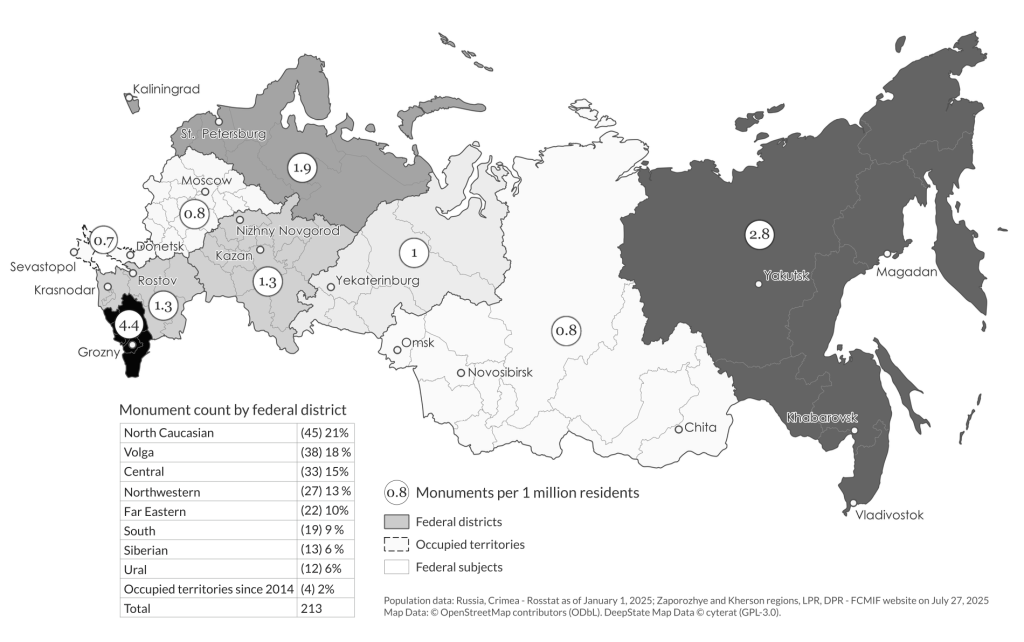
In spatial terms, the 'movable' and 'immovable' memorialisation of Stalin has a specific geography. The majority of 'immovable memory' objects are located in the North Caucasus Federal District, in North Ossetia and Dagestan (21% of all monuments), with the Volga Federal District ranking second in terms of the absolute number of monuments (18%). A search of the Federal Information Address System shows that, apart from Volgograd Airport, there are 29 streets, avenues and lanes in Russia bearing Stalin’s name. In some cases, the name has survived from Stalin’s era, but more often, the streets were renamed over the past 20 years through the efforts of local activists. Twenty-two of the 30 urban sites (78%) named after the leader are also located in the North Caucasus.
Fig. 2. Memorialisation of Stalin by federal district, 1996–2025, %
As can be seen from the data collected, the memorialisation of Stalin is becoming an increasingly commonplace phenomenon. However, we do not detect a clear trend of its growth in recent years. Moreover, it is worth noting that this memorialisation does not appear to constitute any form of official policy: most monuments tend to appear on the periphery. We do not see them being installed in significant urban spaces in major cities. This makes the answers to the key questions all the more significant and complex: what has driven the rise in cases of memorialisation over the past 15 years? What factors influence it? What determines the nature and geography of this memorialisation?
The rehabilitation of Stalin the victor: the dual memorial policy of the early 2010s
The period from 1986 to the late 1990s became, for Russia, an era of a second de-Stalinisation: numerous works of fiction and documents about Stalinist terror were published, the KGB archives were (briefly) opened, and people widely learned about the fate of their repressed relatives. The mainstream was dominated by a new memorial culture, focused on the victims of political terror. In 1990, on the initiative of the Memorial society, the Solovetsky Stone was installed on Lubyanka Square in Moscow; in 1997, a memorial complex to the victims of repression was unveiled in the village of Nasyro-Kort in Ingushetia; and in 2000, a memorial was opened at the site of the Katyn executions of Poles.
Against the backdrop of this public discourse on the victims of totalitarianism, attempts to commemorate the 'leader of the peoples' were rather modest – between 1996 and 2000 only eight new monuments to Stalin were erected. These were mostly the result of individual enthusiasts: for example, in 1998 the headmaster of a school in Chelyabinsk, sympathetic to communist ideas, installed a bust of Stalin in his school, causing a major scandal (fifteen years later, a portrait of Stalin in a school would no longer raise eyebrows).
With the rise to power of Vladimir Putin, Russian society began receiving 'double messages'. On the one hand, Putin reinstated the Soviet (Stalinist in origin) anthem, citing 'public opinion polls' (that is, the will of the people), and called on people not to forget the victory in the Great Patriotic War, ‘which is largely associated with the name of Stalin.’ But at the same time, the new president called Stalin a 'dictator' who 'was largely guided by the interests of maintaining personal power'. In 2010, the State Duma declared Stalin responsible for the mass executions in Katyn: '...the Katyn crime was committed by direct order of Stalin and other Soviet leaders.' During this period, cases of Stalin memorialisation remained isolated, although their number did grow (30 cases of 'immovable' memorialisation between 2001 and 2008).
Against this backdrop of 'double messaging', a struggle between two opposing memorial policies unfolded between 2009 and 2015: one focused on the memory of the regime’s victims, the other on Stalin himself. Our data indicate that it is precisely this period that saw a powerful surge in both 'immovable' and 'movable' memorialisation of the General Secretary.
Fig. 3. Actions to memorialise Stalin, 1996–2025
In 2009, the Communist Party of the Russian Federation (CPRF) solemnly celebrated Stalin’s 130th anniversary, and from that year onwards, communists began organising rallies and motorcades in various cities to mark the anniversaries of Stalin’s birth and death. In 2010, a group of neo-Stalinists came up with the idea of the ‘Stalin bus’. In the following years, ‘Stalin buses’ – ordinary buses decorated with portraits of the 'leader of the peoples' – began to appear in different cities either on the eve of Stalin’s birthday or before 9 May.
At the same time, a gradual change in the Victory Day ritual began. The Soviet ritual of celebrating 9 May, established during the Brezhnev era, and its post-Soviet modifications did not involve the glorification of Stalin. From 2010 onwards, however, each subsequent year saw increasing numbers of portraits of Stalin the Victor and billboards with his quotations appearing in Russian cities during the May festivities (see Graph 3), which often causes scandals. Unlike the ‘Stalin buses,’ this was not a grassroots initiative – in most cases, these portraits were put up by city authorities (although, in some cases, they were pressured by local CPRF branches).
At the same time, public discussion about the victims of Stalin’s repressions still remained in the mainstream, and therefore attempts at public glorification of Stalin provoked heated debate. Moreover, it was precisely during this period that an attempt was made to centralise the commemoration of the victims of Stalinist terror. In 2011, at a meeting of the Presidential Council for Civil Society and Human Rights, political scientist Sergey Karaganov and the head of Memorial, Arseny Roginsky, jointly presented the project ‘On commemorating the memory of the victims of the totalitarian regime and on national reconciliation’. Karaganov justified the need to remember the victims as a task of national reconciliation, since 'everyone was a victim, including the executioners'. Roginsky proposed a concrete list of measures for commemorating the dead and supporting the living, and also insisted on the necessity of erecting a 'central monument' to the victims of repression on behalf of the state, in order to 'signify the state’s attitude towards this problem'. As a result of this landmark meeting, after a long revision process, the Concept of State Policy on Perpetuating the Memory of Victims of Political Repression was adopted in 2015. President Putin solemnly opened the Wall of Grief in Moscow, and the State Museum of the History of the Gulag moved to a new building provided by the Moscow government, along with significant funding.
The second half of the 2010s: the victory of the ‘great past’ over the ‘memory of repression’
A new turn in memorial policy began after the annexation of Crimea in 2014. At the moment when open confrontation with the West began, propaganda placed its bets on the image of a victorious nation ('We can do it again!') and the unifying cult of the USSR’s glorious past. In August 2014, Vladimir Putin, speaking with young scientists, repeated the standard formula of partially justifying Stalin through his wartime victory: although no one denies the camps and the dictatorial nature of Stalin’s regime, 'he won the war' and ‘we did win after all.’
The grassroots initiative 'Immortal Regiment' began to be appropriated by the state, and while in the early years the appearance of Stalin’s portraits at 'Immortal Regiment' marches was condemned, within a few years it became a familiar occurrence.
However, an even more important development was the introduction, in May 2014, of a new article in the Criminal Code on the rehabilitation of Nazism (Article 354.1), which, along with 'denying the facts established by the International Military Tribunal', criminalised the 'dissemination of knowingly false information about the activities of the USSR during the Second World War'. This addition opened the door to prosecuting interpretations of Stalin’s policies before and during the war that were undesirable to the state. As early as 2016, the first conviction was handed down: Denis Luzgin was fined for a post on VKontakte stating that the Second World War began with the joint invasion of Poland by the USSR and Germany (since the full-scale invasion of Ukraine, dozens of people have been convicted and even imprisoned each year under this article).
Finally, in 2015, a monument to the leader was solemnly unveiled at a small military-history museum in the village of Khoroshevo in the Rzhev District. This Stalin memorial, which was already the 67th, marked the first time since 1996 that the unveiling of a Stalin monument was publicly commented on by a federal official: the Minister of Culture, Vladimir Medinsky. He suggested that Russians should come to terms with Stalin: '…to finally put an end to the lingering cult of personality in some people’s heads and stop blaming Stalin for all our current problems and disagreements.' In Medinsky’s view, Stalin and Russians cannot exist without one another: 'All together and without exception – that is our history.'
2015 was the year of a new turn in the official rehabilitation of Stalin the 'victor'. It was in this year – the 70th anniversary of victory in the Second World War – that the number of monuments (17) and performances (21) in his honour sharply increased. In the previous jubilee year, 2010, only 10 monuments were erected and 11 performances were held.
This shift in state policy and rhetoric spurred the enthusiasm of local activists and provided them with additional arguments. In 2018, during public hearings in the Dagestani city of Kaspiysk, the question of renaming Mira Street to Stalin Street was discussed. Musa Abakarov, a teacher at the pedagogical institute, stated that Vladimir Putin wanted the people to venerate Stalin and was subtly hinting at this: 'He [Putin], through his behaviour, is giving us a hint: ‘Come on, lads, come on! Stir up patriotic feelings, rename [Mir Street to Stalin Street]!’ This is the president’s hidden idea. This is a great push, this is inspiration!'
At the same time, the topic of Stalinist repressions ceased to be mainstream. This trend is clearly traceable at the level of big data: in the 2010s, and especially after 2015, the topic of Stalinist repressions increasingly faded from the public sphere. The number of articles in Russian publications mentioning persistent negative expressions such as 'Stalinist terror', 'Stalinist camps', and 'Stalinist repressions' gradually but significantly declined. By 2025, Russian newspapers were writing about the grim past of Stalinist terror three times less frequently than in 1996. This 'muting' of the topic of repressions immediately resonated with a surge of revisionism. The same Musa Abakarov, at the Kaspiysk hearings regarding the restoration of the central street’s name in honour of Stalin, cynically remarked: 'And as for that… [whether Stalin and the Politburo] killed, didn’t kill, whom they killed – that’s a disputed question, we won’t discuss that.'
Fig. 4. Publications with the expressions ‘Stalin's camps,’ ‘Stalin's repressions,’ ‘Stalin's crimes,’ ‘Stalin's terror’ in the Russian media, 1996–2025, % of the total number of publications mentioning Stalin
In the late 2010s, and especially in the early 2020s, following the outbreak of war, the campaign against memorial practices dedicated to the victims of the Stalinist regime intensified: the number of attacks on Last Address plaques increased, monuments to repressed Lithuanians and Poles were demolished, access to memorials was blocked, and museums dedicated to victims of political repression were closed down. By 2023, the opposition of 'executioner versus victim' had finally lost its relevance: a bust of Stalin was erected directly on the site of the execution of six thousand Polish prisoners of war and Soviet citizens – Mednoe in Tver Region. The executioner and the victims together form, paradoxical as it may sound, a 'glorious Soviet past', which, in the eyes of the political elite, is to be a source of pride.
A kind of symbolic conclusion to the struggle between the two lines of memorial policy of the 2010s can be seen in the sharply increased pressure on the Memorial society in the late 2010s, which culminated in the annulment of its official registration in Russia in 2021.
Today, in the mid-2020s, the Kremlin does not require a new personality cult of Stalin, but it does require a cult of the 'Great Victory', in which Stalin-the-Victor will take his place, unclouded by the memory of his crimes. Projects approved at the highest level – such as the gigantic bas-relief depicting Stalin and the Soviet people in honour of the victory in the Great Patriotic War at Moscow’s Taganskaya metro station – are not created anew, but are presented as 'historical reconstructions'. The same logic underlies the restoration of Soviet bas-reliefs, mosaics, and memorial plaques featuring the leader on buildings of city administrations or universities. This is not a new personality cult, but rather an insistent demonstration of the idea of continuity and indivisibility between the great past and the present of the state, as articulated in Medinsky's 2018 programmatic article.
The popular cult of the ‘Stalinist order’ and ‘protest Stalin’
The state-led rehabilitation of Stalin-the-Victor is not the only reason behind the growing memorialisation of Stalin in the 2010s. Equally significant is the popular cult of 'Stalinist order', which has its roots in the late Soviet era.
In 1971, historian Natan Eidelman recorded in his diary the reflections of a high-ranking Party Central Committee official: 'Stalin maintained strict order in the country. A few of his phrases were enough for newspapers to write about them for weeks and months. And now the ‘Number One man’ in the state gives a speech – and the press, after publishing it in full, forgets about it the next day. This is the devaluation of such speeches, as well as much else concerning the actions of our leaders.'
Appeals to Stalin here became a reaction to the desacralisation of leadership that took place under Brezhnev (and earlier under Khrushchev), accompanied by a weakening of 'order'. Followers of this worldview contrasted the 'disorder' observed in the Brezhnev present with an idealised past and its ruler, who, they believed, cared for the people and did not allow injustices against them. This opposition between the present and the utopia of 'Stalinist order' was widely circulated and expressed in fixed formulas, often resembling lamentations: 'Ah, if only Stalin were here!', 'There was order under Stalin', 'This would never have happened under Stalin', and 'Comrade Stalin would have shot you for this.' The irony sometimes embedded in such statements softened but did not negate the underlying message – a longing for authoritative discourse. The set of ideas and practices that created this axiomatic contrast between a flawed present and an ideal past is what we call the cult of Stalinist order.
Formulas relating to the cult of Stalinist order have been repeatedly documented in Soviet diaries (see the Prozhito diary corpus) since the late 1960s. In 1967, writer Vsevolod Ivanov described in his diary how ‘N., who had suffered greatly under Stalin (her husband was arrested, her sister spent a long time in the camps), angry with the doctors, shouted: ‘It’s a pity Stalin isn’t here! He’d have shot them all!’'
In the 1980s, along with growing dissatisfaction with the economic situation, appeals to Stalinist order became commonplace. In 1982, Muscovite Vladimir Bessonov, while on a business trip to Tyumen, described in his diary how discontented people invoked Stalin’s image: 'I am sure: if I stayed here for a month and met even 100 people – every conversation would eventually turn to the same thing: shortages of goods, dissatisfaction with the authorities, meaningless work, carelessness. This is a picture, a signal! But no one hears it. The only thing that alarms me: out of ten people, nine have on their lips the name ‘Stalin’ and the magic word ‘order’.'
References to Stalinist order were made through everyday practices. Muscovites observed portraits of Stalin appearing on dashboards and windscreens of cars (1978, 1980). According to eyewitnesses, a small portrait of the General Secretary was attached to the windscreen of the hearse carrying Varlam Shalamov to burial in 1982. Drivers who decorated their workplaces with Stalin’s image thus demonstrated their civic autonomy and disdain for the contemporary rulers. Handmade portraits and busts of Stalin were in such demand that an underground business for their production and distribution emerged ('…on the train beyond Kharkiv… deaf-mute lads entered the carriage and sold portraits of Stalin, as well as photo-booklets depicting various events from Stalin’s life. Larisa’s compartment neighbour – a woman, deputy director of a Moscow confectionery shop – gladly bought a portrait. No one in the carriage was surprised or outraged by this trade,' diary entry, 1978).
To a significant extent, it was this very cult that was revived in the post-Soviet era and became one of the key drivers of the 'grassroots' rememorialisation of Stalin. In a situation where people feel humiliated and disenfranchised, an appeal to Stalin through the installation of a bust or a billboard becomes a performative way to construct a 'position of strength'. As a result, the mythologeme of Stalinist order has become a form of protest.
One of the authors of these lines (A.A.) and her colleagues spent ten years studying people who participated in political public actions and recording interviews with protesters. Our respondents occasionally contrasted the ‘Stalinist law’ and ‘ideal order’ with the ‘boundless injustice’ against which they were protesting at rallies and pickets. The myth that 'Stalin knew how to care for the people' is so strong that it sometimes begins to outweigh 'normative' political assessments. At a May Day political gathering in St Petersburg in 2016, a pensioner, N., replied to our colleague I.’s question about fighting corruption by appealing to the past: 'I am, in general, against Comrade Stalin, against his methods, but perhaps, half in jest, one could say: we need to bring Stalin back so that he would take heads off, so that he would restore order.'
From the early 2010s onwards, the image of Stalin as an ideal ruler in conflict with the current authorities began to appear on public posters. On billboards hung in Angarsk in 2011, Putin’s self-interest was contrasted with Stalin’s selflessness. The ' Leader of Nations' on the poster declares: 'Working for the good of the Motherland, I owned a single tunic and earned my medals. And what do you have, Comrade Putin?' In 2018, during the mass protests against the construction of a landfill in Shies, a banner with Stalin was also installed in Arkhangelsk. On it, he asks the city's residents: ’Well, comrades, now do you understand who the enemies of the people are?' In 2019, in Neftekamsk, Bashkortostan, a large anonymous banner was put up, on which Stalin sarcastically asks the city's residents how they are doing in modern Russia under capitalism and lists how he cared for the welfare of ‘his children’ – Soviet citizens. In 2021, in the town of Borovichi in the Novgorod Region, a banner was hung with Stalin staring intently at the local Minister of Housing and Utilities and Energy, Irina Nikolaeva, whom local residents accused of unjustified tariff increases. There are no direct invectives (or any words at all) on it. But the very fact that Stalin is staring sternly at the unpopular official is a visualisation of that very phrase, ‘Stalin is not with you!’
Finally, the mythologeme of Stalin’s order also penetrated the ranks of parent-activists campaigning for the improvement of school education. In 2020, activist Dmitry Frontov launched a project to bring back Soviet – ‘the best’ – textbooks to schools and called it ‘Stalin's Primer.’
Dissatisfaction with contemporary life and faith in Stalin’s order drives lone activists to create a protest narrative through the restoration of Stalin monuments on private property and the anonymous hanging of billboards with the General Secretary. Some activists who install plaster Stalins in their gardens openly describe the protest nature of their message. This is precisely the idea that a communist, who in 2015 erected a large statue of Stalin in a Mari settlement, tried to explain to a journalist: ‘Stalin is needed as a reminder: he succeeded, but our leaders have not.’.
Paternalistic utopia: the Communist Party of the Russian Federation's Stalin franchise
The Communist Party of the Russian Federation (CPRF) has adopted the cult of Stalin’s order, using it to create an alternative image of the ideal ruler. Communists from various regions repeat mythologised fragments of Stalin’s biography that emphasise his care for ordinary people and the absence of self-interest in the leader. For example, in 2020, the leader of the Ossetian communists declared: 'Thanks to Stalin, prices fell every year. He sent his children to war, and when he died, he had only 800 roubles left in his account (sic!).'
The communists have turned Stalin into a franchise, providing local activists with 'corporate identity' (red banners, slogans, portraits) and PR support from the central party website and its regional branches (the CPRF’s regional and district committees). The CPRF website reports on every installation of a bust or the opening of a private museum as a party achievement, although in reality these are usually private initiatives with little party involvement. For instance, in a Chuvash village, the grandson of a war veteran commissioned a Stalin bust at his own expense from a fellow party member who was a sculptor, while the website presented it as a major party initiative.
The CPRF website also reports on Stalin museums, which most often are opened by enthusiasts with their own funds and on private premises. However, it did not write about the first such museum, founded by a pensioner in 2002 in Pestovo in the Novgorod region, whose most valuable exhibit was 'Stalin’s plaster ear', a remnant of a Stalin-era monument. Nor does it mention the museum opened in 2005 in Makhachkala by the chairman of the Stalin movement, Azerkhan Pashayev – perhaps because the owner of the museum ‘considers himself to be the main exhibit’: he acts as Stalin's ‘double,’ which does not fit into the parameters of the CPRF's ‘Stalin franchise.’ However, the third ‘first private museum of the leader,’ which has existed in Volgograd since 2006, in the Stalingrad cultural centre on Mamayev Kurgan, enjoys full PR support from the CPRF. This museum properly balances both the local cult of the 'father of the city' and the party policy of glorifying the 'Leader of Nations'. Museums in Irkutsk, Ufa, and Penza, opened within local party offices, are more examples of the CPRF’s 'corporate cult', a kind of 'prayer room'. Several other museums connected to sites of pre-revolutionary exile or the war are also being transformed by the CPRF into 'Stalin museums', though they are not officially named as such. The most ambitious project is the four-storey ‘Stalin Centre’ in Bor, Nizhny Novgorod Region, which, according to its creators, ‘will be the largest of the existing museum complexes dedicated to Joseph Stalin.’ It is also being built by a philanthropist-entrepreneur, owner of three other museums, with his own funds. As a starting point for the project, in 2020 he installed a monument to Stalin there. Five years later, the museum building remains unfinished.
However, the party’s PR strategists place even greater emphasis on rituals of remembrance associated with Stalin. Their first 'trial run' took place on the 'Leader of Nations’' birthday: Yaroslavl’s Komsomol members held a torchlit procession (reminiscent of memorial rituals in Soviet pioneer camps of the 1950s–1970s). In 2009, to mark Stalin’s 130th anniversary, in addition to a ceremonial meeting organised by the communists, local 'Komsomol members' in Rostov-on-Don held ‘festive shootings’.
In the next five years, from 2010 to 2015, the number of performances in Stalin’s honour in Russia more than tripled. On his birthdays and death anniversaries, as well as on dates of old Soviet holidays, the CPRF organises events in various corners of the country: these include ceremonies unveiling busts, memorial plaques and mini-museums of Stalin, rallies 'in defence of citizens’ socio-economic rights', marches with portraits and flowers, motor rallies, running and skiing marathons, literary and artistic competitions, and quizzes.
One of the most popular forms of 'Stalinist' performances has been the car rally: people simply drive from point A to point B in their cars,decorated with red banners and slogans such as 'For the Motherland! For Stalin!‘ along the way, handing out Stalin portraits and CPRF calendars to passers-by and entertaining them with songs such as ’The Artillerymen's March‘ (’Artillerymen, Stalin has given the order!'). These are cheap and cheerful, and they can then declare that 'the participants of the car rally have thus demonstrated to all residents of the district their unforgettable love for the most outstanding leader of our state – J.V. Stalin.' A skiing enthusiast in the Tula region is holding a ‘ski race on the day of remembrance of I.V. Stalin’ with the participation of as many as nine people, and a master of sports in Yakutsk is making an ‘extreme run’ in forty-degree frost. Two residents of neighbouring villages in the Moscow region drive around the local area in their cars, calling it a 'car rally on the day of remembrance of Stalin' (one is tempted to add 'through mud and muddle'). Such events are reported on the party’s website, lending local activities the significance of a nationwide popular movement.
By linking the small with the large, the political with the entertaining, the CPRF provides residents of the most remote regions and isolated villages with an opportunity to connect with the great leader and to engage with the nationwide life of the party. In larger cities, both the scale of events and the role of the territorial franchise agency, the party office, increase. In April 2015, the Komsomol members of Barnaul held a ‘Selfie with Stalin’ event during a Leninist voluntary clean-up day, erecting a temporary bust and inviting townspeople to 'take a photo with the Generalissimo and publish it on the social network Twitter with the hashtag #StalinVictoryBarnaul'. The Komsomol members of Kaluga responded with a campaign called ’Shake Hands with the Leader,' in which participants could insert their head into a cut-out figure of a soldier shaking Stalin’s hand.
In recent years, it is Stalin who has been the main recruiter of new members into the CPRF. The party’s website first mentioned a 'Stalinist recruitment drive' in 2009, reporting that for Stalin’s 130th anniversary 'thousands of patriots decided to become communists' and that 'the cell in the hamlet tripled in size'. Since then, regional branches of the CPRF have regularly reported on 'Stalinist recruitment drives'. The most striking statement came from the communists of Yakutia in 2024: 'The Communist Party of the Russian Federation is open to welcoming into its ranks those for whom the name of Stalin is a symbol of genius and valour.'
The culmination of the communists’ many years of Stalinist devotion was the resolution of the 19th Congress of the CPRF 'On the Restoration of Full Historical Justice in Relation to Joseph Vissarionovich Stalin', which declared Khrushchev’s speech at the XX Congress to be 'erroneous' and any struggle against the cult of personality to be 'destructive'. Stalin has finally become the official central symbol of the party, which portrays itself as 'opposition' within Putin’s system: its main demand upon the regime is to rename Volgograd back to Stalingrad.
As we can see, the CPRF is not the creator of a new Stalinist memorial policy, but it 'rides' both the popular cult of Stalinist order and the state’s course towards the rehabilitation of Stalin’s achievements. Memorial performances in honour of Stalin allow the party to attract new members and to create an image of itself as the people’s defender.
Fellow countryman and the saviour: the Stalin myth in North Ossetia and Dagestan
Attitudes towards Stalin in the North Caucasus are divided between deep affection and intense hatred. In Chechnya, Ingushetia and Karachay-Cherkessia, where memories of Stalin’s deportation of the 'traitor nations' – the Ingush, Chechens and Karachays – remain fresh, opposition to the revival of Stalin’s memory is active, including by Ramzan Kadyrov, and it is impossible to erect a monument to the General Secretary. Moreover, these regions are the only ones in contemporary Russia actively resisting the strengthening of public memory of the dictator. In 2012, when 'Stalin buses' appeared in several cities before 9 May, it was the Chechen diaspora of Yekaterinburg that strongly opposed them, and the 'Stalin bus' was taken off the route. In 2016, the parliament of Karachay-Cherkessia submitted a draft law to the State Duma proposing criminal punishment for denying or approving Stalin’s deportations. In 2017, the parliament of Ingushetia demanded a ban on commemorating Stalin on the territory of the republic. Neither of these laws, however, passed.
Completely opposite views prevail in Dagestan and North Ossetia, where no deportations took place. North Ossetia was the only federal subject that sent a negative review of the Karachay-Cherkess draft law on punishment for denying Stalin’s deportations. And it is precisely in Dagestan and Ossetia, despite protests, that Stalin busts are erected and streets named in his honour. One fifth of all Stalin monuments and museums (46 memorial sites) are located in these two small regions (in fact, there are even more: for some busts, particularly in the Ossetian villages of Gizel and Chermen, we were unable to find the date of installation). Twenty-one of the thirty Russian streets and avenues named after Stalin are also located in Dagestan. Two local myths about the leader are widespread in these two regions: the Dagestan and Ossetian myths.
Fig. 5. Memorialisation of Stalin in geographical terms, 1995–2025
Even at the time of the formation of the Soviet cult of Stalin, there circulated a hypothesis, not supported in scholarly biographies of Stalin, according to which the surname Dzhugashvili was a distorted form of the Ossetian 'Dzugaev'. The notion of Stalin as an Ossetian was widespread during his lifetime and accumulated cultural and political overtones (cf. the famous line '…And the broad chest of an Ossetian' from Osip Mandelstam’s 1933 poem about Stalin – the 'Kremlin mountaineer').
In the 1990s–2000s, against the backdrop of actual wars between Georgia and Ossetia, there was also a memorial war over Stalin. Seeking to oppose themselves to the Georgians, the Ossetians began once again to challenge the Georgian origin of the 'Leader of Nations’' father. For the Ossetians, Stalin is their most famous 'fellow countryman' – to such an extent that from time to time calls arise to have him reburied in his 'homeland'. In 1993, a Committee for the Reburial of the Remains of Joseph Stalin in North Ossetia was established in Vladikavkaz. 'The ashes of Joseph Stalin,' declared the committee's chairman, 'must return to the land of his ancestors.' The Ossetians did not succeed in obtaining the ashes, but preserved and repurposed Soviet busts and streets named after their most famous 'fellow countryman' became the most popular memorial tools by which this small people could assert its identity in its polemics with Georgia.
This specific myth of 'Stalinist identity' also actualises the traditional cult of Stalinist order and 'respect for the working man'. Moreover, here it is accompanied by open criticism of de-Stalinisation: 'The more we criticise Stalin, the more respect for his personality grows among the people, because the people understand that he created not only a great power, but a socialist system in which the working man, the ordinary worker and peasant, was honoured and respected,' said in 2009 Omargaji Aliyev, head of the State Road Supervision Directorate (Your ideas are alien to the people! // Dagestanskaya Pravda. 7 August 2009).
Ossetian radio echoed this: 'The poor consider themselves robbed and desire justice according to the formula: ‘An honest man should live with dignity, a thief should sit in prison’… Despite years of anti-Stalinist propaganda, the image of Stalin, as a symbol of order and justice, commands increasing respect among the people' (Darkness thickens before dawn // Ossetian Radio and Television. 14 January 2018, 19:00).
Dagestan too has its own local myth about Stalin. But there he is not the 'famous fellow countryman', but rather the defender and saviour of the peoples of Dagestan. This myth is based on two events, the first of which actually took place, and the second exists only in folklore. Firstly, in the early years of Soviet power, Stalin proposed that Dagestan should become an autonomous Soviet republic. This is alluded to (though not explicitly stated) on a homemade memorial plaque to Stalin, installed in 2005 on the wall of a café at the railway square in Makhachkala: 'In November 1920, the great Leader of Nations Joseph Vissarionovich Stalin was here at the station en route to Temir-Khan-Shura for the extraordinary congress of the peoples of Dagestan [where he declared its autonomy]'.
Many Dagestanis believe that it was precisely because of Stalin’s special attitude towards Dagestan that, during the deportation of the 'traitor nations', they avoided the fate of the Chechens, Ingush, Karachays and Crimean Tatars. In the 1990s, an historical legend spread widely in popular literature and folklore, according to which the chairman of the Dagestani Council of People’s Commissars, Daniyalov, saved the Dagestanis from deportation in 1944 by persuading Stalin to cancel an already adopted decision during a seven-minute audience. In exchange for avoiding deportation, the Dagestanis were allegedly required to make a 'redemptive sacrifice' and were resettled (in fact, almost deported) to Chechen lands, the inhabitants of which had just been 'forcibly moved' to Central Asia and Siberia. According to another version, the peoples of Dagestan were saved by Lavrentiy Beria, who drew Stalin’s attention to their heroic present and past. According to a third version, Stalin himself personally decided to leave the Dagestanis alone, on condition that they showed perseverance and settled the Chechen territories.
In reality, however, no such meetings or discussions took place (→ Takhnaeva: The modern myth of the failed deportation). Chairman Daniyalov did not travel to Moscow in 1944 to persuade Stalin within seven minutes to cancel the deportation, nor did Lavrentiy Beria meet him. The decision to deport the Chechens and Ingush was taken as early as 1943, and at that time the Politburo also decided to resettle Dagestan inhabitants on the emptied Chechen lands (and there was never any talk of deporting the Dagestanis to Siberia). Yet the myth of the miraculous salvation of the Dagestanis and their 'redemptive sacrifice' offers a convenient explanation for the appearance of Dagestanis in the vacant Chechen houses in 1944–1945.
In any case, as in Ossetia, there exists in Dagestan a myth of Stalin’s special positive role in the fate of the republic and its population, which becomes an additional stimulus for memorial policy. The sacred aura surrounding Stalin’s name manifested itself in a telling episode from Dagestan in 2016. The Dagestani construction company 'Ak-Gel' decided to exploit the cult of Stalinist order in advertising flats. In Makhachkala, posters were installed with Lenin and the caption 'In my day such prices did not exist', as well as with Stalin offering 'Flats for the people'. The Dagestan branch of the CPRF lodged a complaint with the antimonopoly service, and the latter conducted a survey of residents asking whether 'the use of the images of Vladimir Lenin and Joseph Stalin in advertising is ethical'. As a result of the survey, the Dagestani FAS banned such advertising.
Stalin's shields: under the Stalin brand
The Dagestan episode is, moreover, an example of another trend. By this point, cases of using Stalin’s image in advertising were already spreading across the country.
In the 2010s, when the first stage of the state’s rehabilitation of the victorious Generalissimo was unfolding, the grassroots cult of Stalinist order became increasingly visible, while the theme of Stalinist repressions was gradually being washed out of public discourse, and 'Stalinist' gradually began to signify something 'with a quality mark'. The logical outcome of this was Stalin’s penetration into advertising. Today, there are at least ten enterprises in Russia called 'Stalin'. Most often they sell, as one might guess, steel doors and other metal products.
As it turned out in the following years, the leader’s image can sell virtually anything: new flats, tyre fitting services, and even food (or at least attract media attention to these products). In 2012, school exercise books went on sale in Moscow bearing Stalin’s portrait on the cover, and in 2019 the cafeteria of the Russian Museum in St Petersburg offered chocolate bars with the Generalissimo’s image as a compliment to customers ordering cappuccino. Bar and restaurant owners make homemade busts of Stalin, paintings featuring Stalin, and name their establishments after the leader, seeking to attract customers and media attention. In 2025, a café owner in Omsk placed a painted wooden sculpture of Stalin outside his establishment, and a restaurant owner in Belgorod hung a painting depicting 'Stalin shaking hands with Putin' (Putin’s head was affixed to the body of a soldier in a retro ceremonial uniform).
The growing normalisation of Stalin has led to portraits of the General Secretary being hung in officials’ offices (and not necessarily all of them connected with the CPRF). It seems the first to do so publicly was a deputy of the Krasnoyarsk regional legislature as early as 2004. In 2016, a State Duma deputy and the governor of Stavropol reported having portraits of Stalin in their offices, in 2017 a photograph of Stalin holding a girl was seen in the reception area of the children’s ombudsman of the Yaroslavl region. Finally, in 2024, the governor of Vologda displayed a painting hanging in his office depicting Stalin shaking his hand. Needless to say, in online shops, portraits of Stalin 'for offices and workplaces' are widely available.
How far the normalisation of Stalin has gone is illustrated by the following story. While the Russian media mentions Stalinist repressions less and less, the number of articles (over a hundred publications) recommending readers prepare Stalin's favourite dishes and drinks has noticeably grown ('tired of ordinary soups – cook Stalin’s cabbage soup', 'Stalin kebabs for a cosy time with friends'). The narrative of Stalin’s private life – what he liked to eat and drink – is seeping into Russians’ everyday lives. Yet this seemingly innocent 'domestication' of Stalin is far from innocent, because it normalises everything associated with Stalin’s name – the cult of violence and the low value of human life. It is symbolic that recipes for the 'leader’s favourite wines' and 'cabbage soup' are interspersed online with adverts for contract military service, where young people are persistently urged to enrol as 'Stalin’s falcons' (that is, as combat drone operators).
Fig. 6. Mentions of Stalin's ‘favourite dishes’ in the Russian media, 2000–2025, % of total publications mentioning Stalin.
Conclusion
The answer to the main question – whether the country is undergoing re-Stalinisation – appears ambiguous.
There are no signs that the restoration of Stalin’s cult is a deliberate state policy. Putin’s elite does not require the cult of Stalin for its own sake. Contemporary 're-Stalinisation' is composed of several mythologemes about the 'Father of Nations': there is Stalin the war victor, Stalin the people’s protector and guarantor of paternalistic order, and Stalin the patron of certain Caucasian peoples, helping them survive and preserve their identity. These different Stalins provoke the formation of distinct rituals and memorial practices.
Stalin the commander was necessary for Putin’s political elite to create a new Victory Day ritual, designed to unite Russians and shield this victory from 'Western insinuations' that question its moral and historical value. This image of Stalin the victor reinforces the notion of a strong state and serves as a historical justification for the policies of the current ruler, legitimising the war he has unleashed.
Stalin the protector is the ideal paternalistic ruler who, in the opinion of many Russians, helped ordinary people by restraining the appetites of those in power and maintaining order, even by extremely brutal means. He is often invoked in the search for justice and as a means of criticising the existing regime. In the case of Ossetia and Dagestan, this myth takes on a particularly national dimension.
The image of Stalin the leader, which the Communist Party of the Russian Federation has made its own brand, draws on both these mythologemes – as the creator of a great power and as the ideal patron.
As can be seen from the data we have gathered on the rememorialisation of Stalin, it still does not possess a mass character. However, the increase in the number of monuments and memorial practices associated with Stalin demonstrates the 'normalisation' of his image, which displaces the topic of Stalinist repressions from the focus of public attention. The growing emphasis on Stalin’s achievements in such a situation becomes an instrument of indirect normalisation of a new wave of escalating repressions, which appear as an inalienable attribute of the inherited 'greatness'.